Oscar Bonilla, PhD
2026 presents a unique window of opportunity for anyone looking to start their journey toward financial freedom. With a U.S. stock market that has shown historical resilience, interest rates undergoing normalization, and democratized access to financial instruments once reserved for institutions, the barriers to entry have never been lower.
But lower doesn't mean easier. The difference between those who capitalize on this window and those who lose their capital comes down to one single factor: having a structured plan.
The Mistake 90% of New Traders Make
According to data analyzed in studies of the Brazilian market published in the Journal of Financial Markets, 97% of traders who trade for more than 300 days lose money. In an analysis of 1,551 individual traders between 2012 and 2017, only 17 people (1.1%) earned more than minimum wage, and a mere 8 (0.5%) earned more than a bank teller.
The main reason? It isn't a lack of tools or information—it's the lack of a structured process and the inability to manage emotions.
Trading without structure is like building a house without blueprints. You might raise the walls, but it will fall down.
— Oscar Bonilla, PhD
Step 1: Calculate Your Financial Freedom Number
Before opening a brokerage account, you need to answer a question that 95% of people can't: how much money do you need monthly to live without relying on a job?
- Add up all your fixed monthly expenses (rent, utilities, food, transportation, healthcare, debt payments)
- Eliminate phantom spending that adds no value to your life
- Multiply the total by 15 (12 months + a 3-month safety cushion)
That number is your goal. For most people, it's between $50,000 and $200,000—not the millions popular culture suggests. Oscar achieved financial freedom at age 33 starting with an initial capital of $10,000.
Step 2: Choose the Right Vehicle
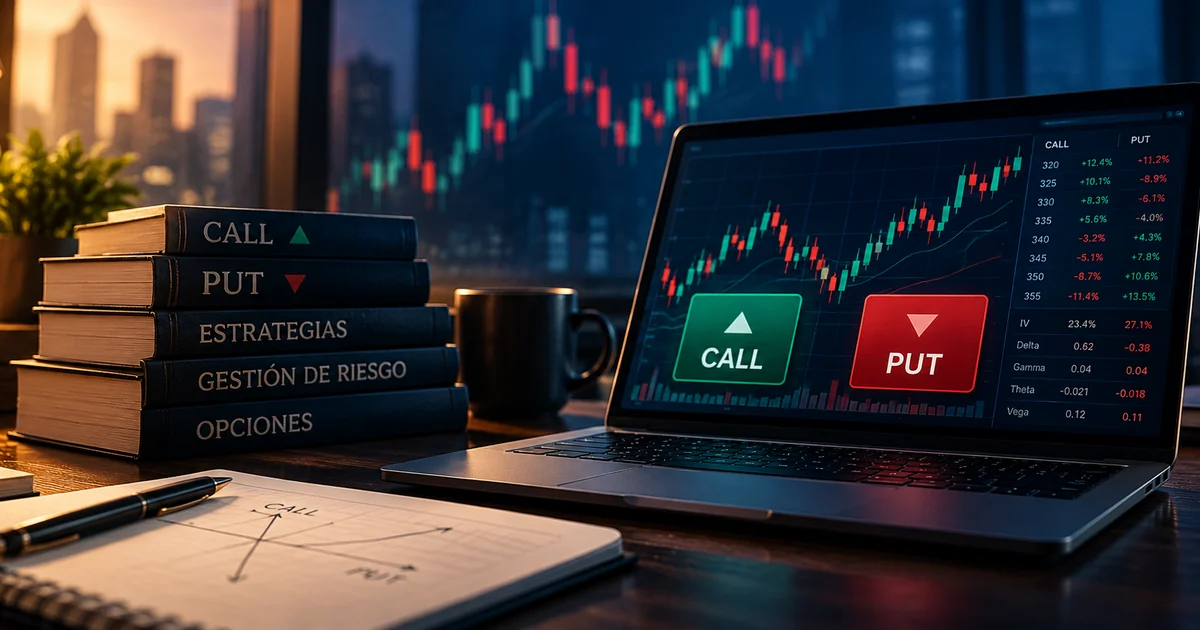
Not all financial instruments are created equal. Oscar recommends focusing on stock options in the U.S. market for specific reasons:
- Low capital requirement: you can start with less than $500, unlike stocks where you need $25,000+ to day trade (PDT rule)
- Built-in leverage: each contract controls 100 shares, multiplying the impact of every move
- Defined risk: when buying options, the absolute most you can lose is the premium paid for the contract
- Two-way opportunities: you can profit whether the market moves up (calls) or down (puts)
Step 3: Build Your Risk Management Strategy Before Your First Trade
This is the step 90% of new traders skip—and it's the most critical one. Oscar calls it "the emotional shield":
- The 2% Rule: never risk more than 2% of your total capital on a single trade
- Defined stop loss: know your exact exit price before entering if the market moves against you
- Minimum 2:1 ratio: only enter trades where the potential reward is at least double the potential risk
- Separate practice capital: start with penny stocks ($0.10-$0.20 per share) to build the habit without emotional pressure
Don't disrespect your risk level. It's exactly like jumping into the void.
— Oscar Bonilla, PhD
Step 4: Develop a Professional Trader's Mindset
Research by Kahneman and Tversky demonstrated that the pain of losing $100 feels twice as intense as the joy of gaining $100. This bias—loss aversion—is the single biggest sabotage factor for traders lacking psychological preparation.
The 4 fears you must learn to manage:
- Fear of being wrong: no trade comes with 100% certainty. Professionals are right between 40% and 60% of the time
- Fear of losing money: solved with bulletproof risk management (your maximum loss is already set before entering)
- FOMO: the market opens every day. There will always be another opportunity
- Fear of leaving money on the table: trailing stop loss orders automate your exit so you don't make emotional decisions
Step 5: Create Your Daily Trading Routine
Oscar recommends a daily structure that his students have successfully put to the test:
- Pre-market (8:00 - 9:30 AM ET): review economic news, daily earnings reports, and key levels. Do not open your trading platform yet
- First hour (9:30 - 10:30 AM ET): peak volatility. Wait through the first 15 minutes for direction to establish. Execute planned trades
- Midday (10:30 AM - 2:00 PM ET): lower volatility. Manage open positions, adjust stops, and take partial profits
- Final hour (3:00 - 4:00 PM ET): second volatility window. Close positions to avoid holding overnight risk
- Post-market: fill out your trading journal. Log every trade, the reasoning behind it, your emotions, and the outcome
The 2026 Context: Why Now
Several factors make 2026 a particularly favorable moment:
- Democratized access: platforms like Webull, Robinhood, TD Ameritrade, and Interactive Brokers let you open accounts with no minimums and zero commission on many instruments
- Accessible education: high-quality free content (like Oscar's YouTube channel) allows you to learn the basics with zero upfront investment
- Actionable volatility: markets continue to show significant intraday volatility, creating daily opportunities for prepared traders
- Technology: technical analysis tools that used to cost thousands of dollars a month are now available for free or at very low cost
The Roadmap: From Beginner to Consistent Trader
The first three months are dedicated to education and practicing with minimal risk. Months four through six mark the transition to trading options with real—but small—capital. And only after logging a minimum of 100 recorded trades with a net positive result do you gradually scale up your capital.
Financial freedom isn't an event. It's a process. And that process starts with the decision to begin.
— Oscar Bonilla, PhD
Oscar Bonilla achieved financial freedom at age 33. Today he manages a fund exceeding $6 million, a $7 million real estate portfolio, and private equity investments topping $1 million. It all started with $10,000 and a plan.
The question isn't whether it's possible. The question is: are you willing to follow the process?
Trader statistics are derived from research published in the Journal of Financial Markets (Barber et al., 2014). Data regarding loss aversion comes from Kahneman and Tversky's Prospect Theory (1979).